
Disabled-led spaces bring me closer to all I’ve ever wanted
Life imitating art

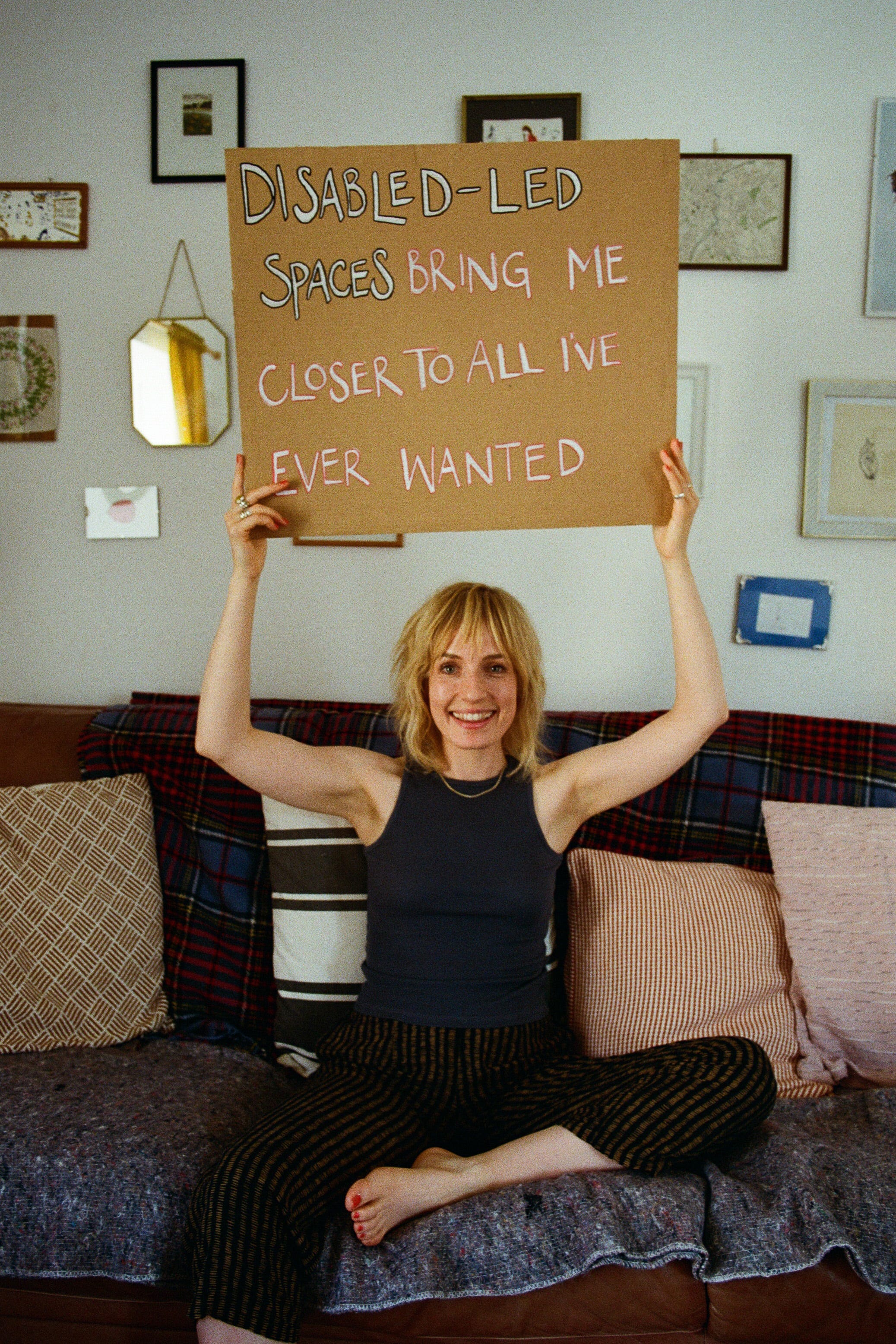
My body is an art.
I am one of 50 captured by visual artist, and precious friend, Emma Bentley-Fox for a new exhibition aiming to reflect the breadth and depth of disabled resistance. Emma travelled to all corners of West Yorkshire to photograph disabled and chronically ill creatives along with a sign. A message. To our government; to the ‘outside world’; to each other.
In the context of everything that’s happening, of all the things I could’ve said, why did I write this?
Disabled-led spaces bring me closer to everything I’ve ever wanted
Well.
Most and many of the other 49 sentiments speak for me too. I am also worried. I am also furious. I too am calling for compassion, understanding, inclusion and basic human care. This collection of signs works because we’re all different, and yet.
I admitted to Emma that the right words for my cardboard weren’t rushing to mind. I was walking through fog that day, intermittently but enough to feel frustrated at my lack of access to words right when I needed it. We chatted over tea about what might need to be said. By me. That day.
Because a chronically ill body moves like a tide and changes like weather. To be in touch with its ebb and flow is to have an acute sense of what’s right or wrong, possible or more challenging, in most moments. The right thing to be saying, doing or scoping washes up on the shore and I pick up the shell. Hold it in my palm. Sometimes I study it. Sometimes I slip it into a bag of precious things to study another time. Emma and I talk about our experiences of illness. When did it happen? How suddenly? When did the first flickers of acceptance arrive? What does it look like when we fight it? My fog doesn’t lift, but it circles around my ankles and the backs of my eyes, then settles, like an old and loyal dog by a fire. The three of us settle together. We can settle together because Emma ‘gets it’. We are different, and yet.
To negotiate the world in a disabled body is to live artfully. It’s to problem solve, imagine what does not yet exist and make it so. To craft space together is to perform everyday miracles. I once spent two days in a room designed in response to more than forty access riders and it was brilliant. Caring for your body is not too much effort. To shape this space by the curve of our needs is not ‘going out of our way’, it’s a way worth going. For everybody. No one is made poorer by a disabled led space. The relief of the unspoken knowns - Gah. Please don’t misunderstand me; I am not describing faultless utopia. We are human beings - these spaces are not perfect - but that’s why they’re perfect. They are knowingly shaped by fleshiness. By the assumption that temperature fluctuates and appetites shift. By the assumption that ‘on foot’ is not the only or best means of travel. Imagine being in a room that already assumes you will get tired, you will be excited, that you are smart and knowledgeable and in need of support. A baseline of gratitude for your presence; resources are finite, thank you for choosing to spend them here. Does a non-disabled body have different parameters? Of course not. The edges may have different coordinates, but it remains true that all bodies have limits, gifts, challenges and best conditions for their flourishing. I just prefer being in spaces that acknowledge these truths.
Disabled people are the world’s largest minority. Our bodies are inherently political. The quiet shadow of opportunity to live differently, more equitably, runs parallel to the everyday bin fire. The world’s best kept secret in plain sight. I could write, say, scream thousands of words about how purposefully cruel and objectively deathly the UK government’s decisions are. I could plainly share the various points in history when disabled bodies were considered a hindrance. Or I can point steadfastly to one of the most beautiful things I’ve known. Interconnected, interdependent, deeply listening, inherently curious, ‘fuck it let’s try’ ways of living. Resistance. Creation - between bodies that work with, through and beyond one another. Something it’s not possible to take away.
Rights Cuts Action: The creativity of disabled resistance is open at Shape Arts in High Wycombe from Monday 6 October until Wednesday 5 November 2025 featuring artists Emma Bentley Fox, Anna Berry, Elora Kadir, Fae Kilburn, Vince Laws, Zoe Milner, Guy Morris, Déa Neile-Hopton, Kristin Rawcliffe, Ivan Riches, Benedict Robinson, and Kim Waine-Thomas.
I love this. I have been staring wide eyed at all of the craziness around us and I keep asking myself the same question - how do we live now? How do we work so that it doesn’t get worse, so that there’s a chance it could get better? I guess another way to say it is ‘how do we resist?’ And this… your blog, the creativity of your community… this is a beautiful picture of how. Thanks for sharing. X
knowingly shaped by fleshiness.